13 Jan 2026

data-driven
When you organize an event, sometimes a local TV news van shows up. And people ask, “are we going to be on the news?” The answer is almost certainly yes. The station only has so many vans. The decision about whether or not the event is newsworthy was made when they decided to send the van.
That’s what’s bogus about “data-driven” organizations. They’re still making decisions based on their values and on vibes, but the decision-making step is moved, to the step where they decide what data to collect to justify the decision.
Here’s a good recent example. When you cancel Microsoft 365 Business Basic (which is, as far as I can tell, one of the confusing names for what’s basically “MS-Office on the web”) you get a survey about why you decided to cancel.
Here are the options:
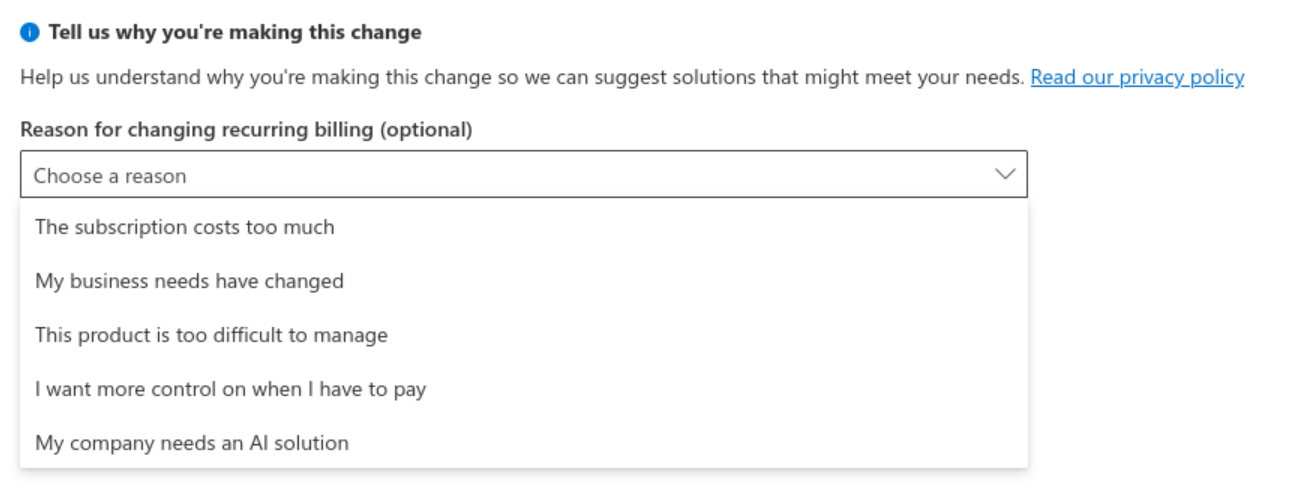
Notice anything? There’s an option for “My company needs an AI solution” but no option for “This service has too much AI”. So back at slop HQ in Redmond, Washington, they’re going to be making “data-driven” decisions based on how many customers left because they wanted more “AI” but they get no data pointing the other way.
ICYMI, a toot from Charlie Stross explaining why he canceled “Microsoft Office 365” (which is possibly the same thing as the above? It’s a platinum sandwich situation with MS-Office and Office-adjacent products and services over there now.)
CoPilot in Office would open me up to accusations of breach of contract—my book contracts warrant that they’re all my own work: CoPilot brings that into question.
This could be a whole niche for an office suite. A lot of people are using office software to make some kind of files (documents or presentations or whatever) that they have already signed a contract about, promising that the files will be their own original work. And a lot of them know Microsoft Office already and would prefer not to have to learn LibreOffice, the maintained successor of OpenOffice. Is there a market opportunity for “Microsoft Office: Authentic Human Content Edition”? Maybe, but the way that the “data-driven” process works, Microsoft will never know.
For what it’s worth, the “data-driven” situation is a big part of why corporate internal prediction markets never took off. Prediction markets have a bad habit of contradicting things that executives just know, on vibes. More: How we get to the end of prediction market winter
Bonus links
Battle
Lines Are Drawn (Predictions 2026, #2) by John Battelle. 2026
will be the year that AI becomes a proxy for escalating social conflict,
across many connecting but distinct sectors, including politics,
business, culture/arts, health, and education.
Its Your Job To Keep Your Secrets by Robin Hanson. (And underground prediction markets will pop up if there is demand from leakers for a place to trade on what they know, anyway. Someone made a ton of money betting on Maduro’s capture. Related short fiction: The Hedge)
Furious AI Users Say Their Prompts Are Being Plagiarized (lol)
In First Attack By UUV, Ukraine’s ‘Sub Sea Baby’ Drone Blasted Russian Black Sea Kilo Submarine - Inside Unmanned Systems by Sebastien Roblin. (another reason why the “security tax” on fossil fuels is clearly underestimated.)
When Google Locked the Door, Three MIT Students Picked the Lock by Harkaram Grewal. (Remember what Google did to the codec patent cartel? It’s like that but for biochemistry AI)
Resistance honeypots by Heather Burns. “If you are running guides to safe protest, countersurveillance, or personal/operational security, but you have not done a thing about the adtech on the page, you are not helping your readers, you are harming them.” (Personally I would go further…if you are running any kind of independent privacy site and are not warning readers who have the surveillance crap turned on, you’re doing it wrong. I need to fix that on this site. If enough independent sites nudge people into better protection, things will be harder for the surveillance business.)
Mamdani Announces Full McGuinness Road Diet, Finishing a Job Halted by Adams (meanwhile, Former NYC Mayor Eric Adams’ memecoin faces rug pull allegations)
The
Year of the 3D Printed Miniature (And Other Lies We Tell Ourselves)
by Mat Duggan. So when a friend asked me what I thought about “insert
new revolutionary technology that will change everything” this week, my
brain immediately jumped to
it’ll be like 3D printers and
Warhammer.