Update: “Surviving the
Rugpull Economy” is on YouTube for anyone who wants the video
version.
Abstract
The story of open source and the Internet is a story of dystopia
timelines that didn’t happen. We avoided the Clipper Chip, key escrow.
And the Fritz Chip, DRM mandates. Sure, threats to security, and DRM
lock-in, are still there, but thanks to a lot of hard work, they’re
manageable. Today’s biggest threat, though, isn’t coming from outside
forces like governments or big copyright holders. Our ongoing collapse
of trust and rise of crime is rooted in some good ideas from open
source, gone wrong.
It’s not just social media scams and deepfakes. Dishonest business
practices from the sketchier corners of the Internet have gone
mainstream. We’re in a rugpull economy now. Let’s figure out where we
went wrong and how to get back on track.
Intro
I was going to give my practical privacy tips talk, but then it turned out
that they gave me
the big room, so I wanted to think about the big picture.
Why are we doing privacy tips in the first place? Why not: How to
share more of your personal information with brands you love? Why is
privacy even a feature?
Privacy is not about something to hide. In a lot of situations, the
reason we have privacy is that it makes a market work. Imagine you go on
vacation, and go to an old-fashioned rug market. Are you going to hand
every rug merchant your shopping list, budget, and departure date?
The basics of privacy are like the basics of not showing your cards
in a card game. When privacy breaks down, a lot of other human
activities break down, including markets.
Normie corporate privacy
And, of course, there are a lot of deceptive people out there. So the
stuff that we used to do as privacy nerds has gotten all mainstream and
corporate.
The Federal
Trade Commission says scams are up 3x since 2020.
The Pew Research Center, in Online
Scams and Attacks in America Today, says that 73% of U.S. adults
have experienced some kind of online scam or attack.
When you give up too much information, you make it too easy to target
you. Scams you’re likely to believe, malware that looks like software
you want, whatever. So the kind of privacy advice I used to share with
privacy nerds is now part of mainstream corporate IT best practices. CSO
Online recommends:
Push a vetted ad-blocking extension to managed browsers through
policy rather than leaving it to users to install it.
Favor browsers with built-in tracking protection.
Block ad and tracking domains at the DNS or secure web gateway
layer; this reaches in-app ads on managed phones.
Disable advertising identifiers on corporate mobile devices
through mobile device management (MDM) and restrict ad-supported
consumer apps on devices holding sensitive data.
Wherefore do the wicked prosper?
How did it get so far?
The prophet Jeremiah asked,
Wherefore doth the way of the wicked prosper? wherefore are all they
happy that deal very treacherously?
That’s not what I expected the Internet would get us. The Internet,
and free software, were going to be awesome. I started running desktop
Linux in 1994, back when you had to exit your own X mode lines, and you
could zorch your (tube) monitor if you got it wrong. Yes, that was
actually a thing.
Linux and the Internet kept getting better.
Internet 2, dystopia 0
The open source scene has beaten some powerful dystopia
narratives.
Encryption backdoors and DRM are both still around, but last I
checked the one remaining device in my house that will play DVDs is one
of the Linux boxes. Both have gone from extinction-level threat to
manageable problem.
Yes, we still need to get political and stay political to keep them
from coming back, but for now, open source and the Internet have
won.
Now the dystopia is coming from inside the house
But now we have dystopia at home.
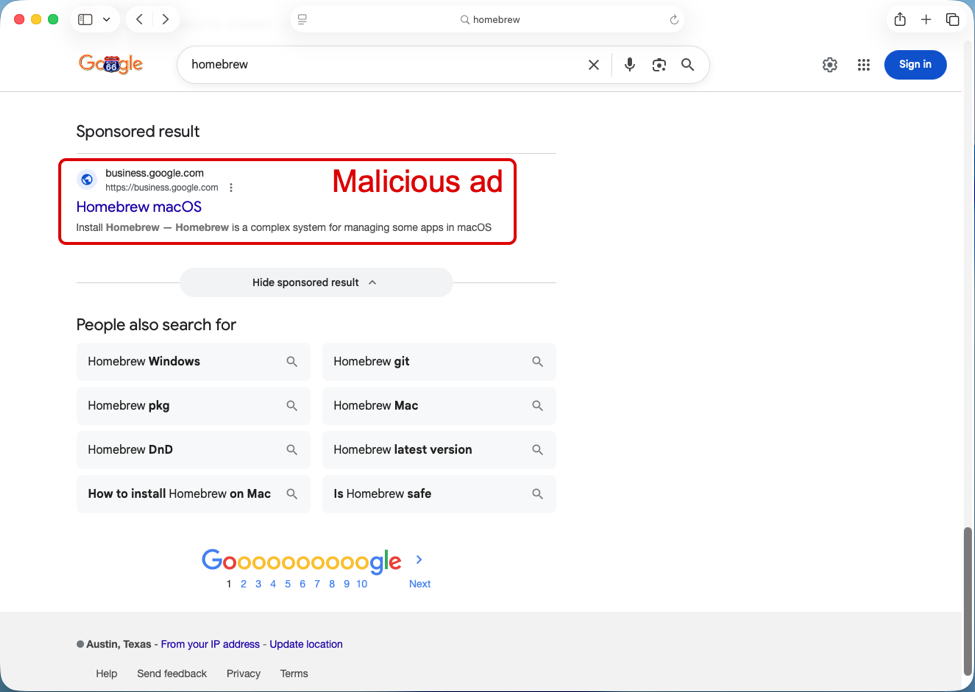
A public
service announcement from the FBI says “cyber criminals are using
search engine advertisement services to impersonate brands and direct
users to malicious sites.
And the FBI recommends installing an ad blocker. We are on the way to
an new kind of dystopia when a major law enforcement agency of the USA
is saying that a major company in the USA is doing so much crime you got
to just block them. So how did we get here?
Today’s scam and surveillance dystopia has its roots in the open
source scene.
We can still beat this one, and this time it’s really on us.
From open source to surveillance dystopia by way of economics
Commoditize
the complement was awesome back in the days of “old Google.” Replace
expensive single-vendor systems with Linux, plus whatever hardware works
best at the time for a reasonable price.
Hardware as a commodity was a good idea. The problem happened when
“content” was treated as a commodity. Adtech constantly tries to get the
most expensive possible ad into the cheapest possible context.
For adtech, surveillance was never about the surveillance. It was
about connecting the reader of some expensive content to some other
context where you could show them an ad for cheaper.
A recent paper shows I’m right. A Longitudinal Study of
Extended User IDs in the Online Advertising Ecosystem, by Michael
Smith, Riley Grossman, Krzysztof Franaszek, Antonio Torres-Agüero,
Pritam Sen, Cristian Borcea, and Yi Chen, describes how web trackers are
giving “user IDs” to bots. If it were about the surveillance, this would
have been a big deal. But it wasn’t. (A small
mention in AdExchanger, that’s about it.) Adtech is a racket against
the web publisher.
Why did advertising-supported web sites turn out to be so hard?
The old magazine business model was something like this:
subscriptions cover the cost of printing and postage, and ads pay for
the content. Without printing and postage, the ads should pay for
things. But it didn’t work.
Walt Mossberg recalled,
[W]e were seated next to the head of this advertising company, who
said to me something like, “Well, I really always liked AllThingsD and
in your first week I think Recode’s produced some really interesting
stuff.” And I said, “Great, so you’re going to advertise there, right?
Or place ads there.” And he said, “Well, let me just tell you the truth.
We’re going to place ads there for a little bit, we’re going to drop
cookies, we’re going to figure out who your readers are, we’re going to
find out what other websites they go to that are way cheaper than your
website and then we’re gonna pull our ads from your website and move
them there.”
The first generation of adtech was all about good ad, bad
context.
But then it got worse.
The “progress” of online advertising was in creating ever more
efficient auction-based markets, to match an ad to a user in real time.
In 2006, Jakob Nielsen pointed out the problem with those, in Search
Engines as Leeches on the Web. An auction-based market tends to
capture all the advertisers’ profits, as they bid up the price of ads to
where the cost of the ad equals the expected profit from additional
customer.
As the auction gets more and more efficient, some slots go un-sold.
Which explains why Big Tech systems are now deliberately
designed to match scammers and victims.
The biggest example of adversarial personalization is the Big Tech
senior fraud situation. Many older people are spending less money on
discretionary purchases but are sitting on retirement savings, so Big
Tech ML systems automatically “learn” to match them not with legit
products and services, but with fraud operators.
Scam bidders don’t just fill in the ad impressions to the people
normal advertisers don’t want (or, that Google and Meta ML “learns” not
to serve normal ads to). Meta
is earning a fortune on a deluge of fraudulent ads, but those
fraudulent advertisers are also acting as shill bidders to drive up the
auction prices for the legit advertisers.
Meta makes 10% of ad revenue from fraud directly—but possibly much
more because the bidding functions representing all the other ads must
pay more in order to outbid the numerous scams. If
Meta is so good at AI then what’s this doing here?
Number must go up
Advertising revenue globally is about a trillion dollars, hard to
estimate, maybe a little more. Meta and Google ad revenue, added
together, is about half that. 580 billion if you add their Q2 2026
revenue and annualize it (multiply the quarterly number by four). The
only way left to grow is to keep taking
a bigger and bigger fraction of every sale, and the way to do that
to keep dumping more good ads into bad contexts, and scam and malware
ads everywhere.
A majority of a major industry is now controlled by two transnational
crime organizations.
Crime is inevitable for Meta and Google now that they control a
majority of advertising but must continue to grow at startup-like
rates.
Excuses, excuses
But this platform, it’s so big! This is why you
don’t hire a Big Tech CEO to manage a Burger King. “There are so many
Burger Kings with so many customers! How could we possibly mop all the
restrooms?” You just have to hire enough people. And if the rules of the
platform ad “game” were less scam-friendly, less work by employees would
be required anyway.
But union busting! Don’t Big Tech CEOs hate hiring
moderators? Especially moderators who unionize? The crime is built in to
the rules of the ad system, not just in the amount of work
invested.
The problem isn’t scale or labor/management issues. The problem is
deliberate design and policy decisions. Two good examples are:
What legit brands need from advertising
Advertising works when
content + signal ≥ interruption + resources + risk
Advertising can provide two benefits to the audience: it can support
some kind of resource (which technically doesn’t have to be “content,”
bus bench ads are a thing, too) and it can send a credible signal of the
advertiser’s intentions in the market.
And advertising asks the audience to pay, with some kind of
interruption—otherwise it would be not advertising, but content
marketing—and spend some kind of resources, such as battery and
bandwidth, and often accept some kind of risk.
Michael Farmer points out that:
The 2009-2024 sales growth rate of 40 out of 60 major advertisers
has been very depressed, averaging (as a group) only 2% per year for 15
years.
By contrast, the market had real GDP growth of 2.4% per year plus
inflation of 2.3% per year — so the benchmarked nominal GDP growth rate
was 4.7% per year.
Advertising has stopped working for legit brands, and very few people
in the ad industry have paid attention. So much crime,
so little pay.
What I was wrong about
I thought that legit brands would want some form of post-creepy
advertising, designed for honest sellers. What I did was point out the
ad medium/brand mismatch. I did say that today’s surveillance
advertising is optimized for the needs of deceptive sellers, and doesn’t
carry the signal that legitimate brands need. Right so far.
But here’s where I messed up. As an Internet Optimist, I assumed that
the decision-makers for the highest-reputation brands would be
dissatisfied enough with the situation to seek out advertising media
better suited to costly signaling.
But that’s not what was happening, if I had been paying attention to
other trends.
Brand decision-makers did take steps to deal with the problem that a
higher-reputation brand doesn’t benefit from an advertising system
optimized for lower-quality sellers—but did it the other way around, by
cutting quality and/or service and burning brand reputation.
But I was
wrong about ad reform. Brands let their quality and reputation slide
in order to match the available advertising, not the other way
around.
Bernadette Banner, an expert in historic garments and in making and
altering clothing in general, did a video on selecting
fabrics. But in a rugpull economy, that’s harder than it looks.
The unfortunate reality is that those sorts of recommendations do not
stand the test of time The recommendation section will become obsolete
especially when shops start going out of business, especially the really
highly recommended small businesses. Or with bigger more reliable brands
it’s very common that these get bought up by private equity and become
enshittified and so their quality degrades.
So what can we do about it?
This is our mess to clean up.
We’re not going to get off the Internet and touch grass. Get to the
public library and volunteer to help people get their privacy issues
fixed.
TODO add link to Alameda library drop-in help sessions.
Privacy is a collective problem. It’s not personal. We’re all safer
when less money is flowing to scammers and to Big Tech.
And people inside big companies want to do the right thing, you just
have to be able to justify it. I still think Google could go
legit again.