22 Oct 2026

CCPA and CIPA on the same site
Some jurisdictions have consent-based privacy laws.
Some jurisdictions have opt-outs.
And then there’s California. We have both. For CIPA you need consent, for CCPA you have to handle opt-outs, including Global Privacy Control (GPC).
Sites are going through the five stages of CIPA getting this stuff set up right. A few have it down, while others, not so much.
Some of the site features that are set up to comply with one law are creating problems under the other.
The right way
Here’s how to get compliance with both, with minimal risk and the least possible hassle for the user. Developing this now (or realistically not now now, it is Q4) will save a lot of boring but high-stakes compliance meetings.
Check for a consent cookie (or a logged-on user who has already consented). If consent is on, go to step 6.
Check GPC. If it’s on, go to step 7.
Show the consent dialog, along with CCPA and CalOPPA required features such as link to privacy policy.
Is Rewarded Interest running? Rewarded Interest suppresses the consent dialog and shares CMAID. Go to step 6.
User makes a choice. If the user declines consent, go to step 8.
Set or refresh the consent cookie. Load cross-context tracking scripts. END.
Acknowledge the user’s GPC in the page footer.
Continue without cross-context tracking scripts. END.
Eight steps looks like a lot at first, but look, we only have two END states, and the only people who have to see the consent dialog are visitors with neither GPC nor Rewarded Interest.
One more step that has to happen when the user transitions from a logged-off to a logged-on state, or if they arrive with a valid session cookie that identifies them. Check for the consent cookie, and if it’s not present, then flag the user’s record in the CRM system as “do not sell or share”. That’s basically a CCPA thing. You can’t just do opt-outs as a front-end task, they have to affect server-to-server traffic, too. And if the user changes their profile to allow tracking, set the consent cookie when they log in.
Update: For CIPA you need to get “consent to wiretapping” that is acceptable to a California jury. The weak EU-style “consent” to data processing that Irish regulators tolerate is not really useful here. Don’t re-use GDPR design or copy for CIPA. (It is often easier to reform a problematic data practice than to try to explain it in a way that’s clear enough to get meaningful consent to it.)
Somewhere around the whole consent rigmarole is going to be an opportunity to promote Rewarded Interest to people who would likely want it. That would give them a better experience in future. (Likely GPC users are already getting that option promoted to them by the privacy scene.)
And of course some pages have to work without third-party tracking at all (such as the privacy policy and ToS pages. You can’t block the privacy policy page with a consent dialog.)
So that’s the right way, what about some…interesting…CIPA/CCPA mash-ups?
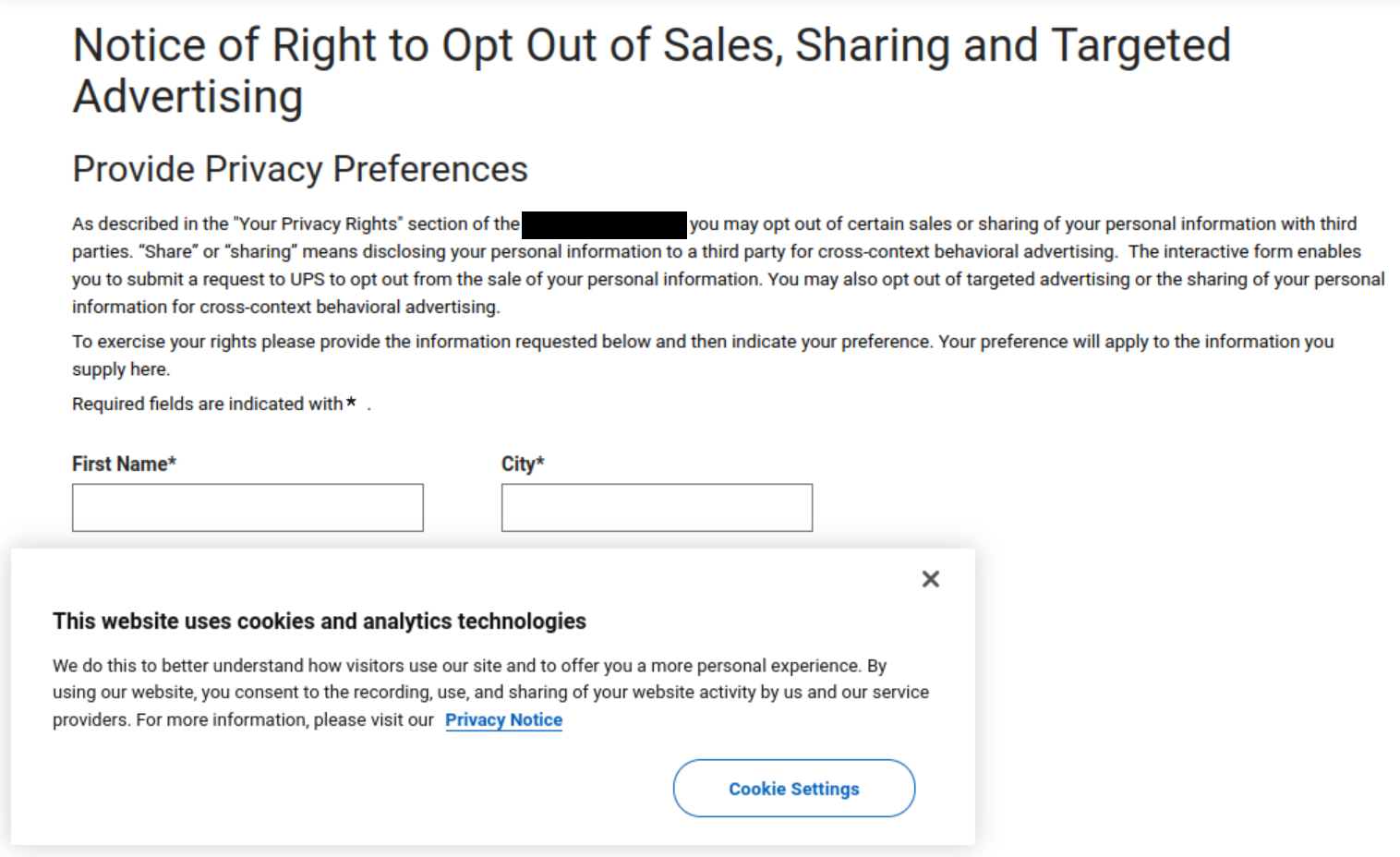
Wrong: break CCPA compliance trying to do CIPA
All of the wrong ways are basically do a bunch of extra compliance tickets and create a bunch of extra risks. And they’re more complicated than the steps above. TODO: learn Mermaid so I can diagram how hairy some of these are.
The first wrong way is CIPA consent UX that blocks the CCPA and CalOPPA required features. We don’t just have two privacy laws here, we have two parallel systems but way more than two laws. Don’t forget the Online Privacy Protection Act of 2003 (CalOPPA).
You can’t block people from the CCPA/CalOPPA stuff just to get them to do the CIPA stuff first. All the compliance tickets have to take into account the work done on the other compliance tickets.
Wrong: relying on CIPA consent to do “wiretapping” but not “sale or sharing”
Some lawyers claim a path through the legal weeds of the definitions of “wiretapping” and “sale or sharing” that makes it technically possible to load some third-party trackers with the right configuration to do something slightly different for the users who have given consent under CIPA but are still opted out under CCPA.
That’s just a recipe for explaining to CalPrivacy why the site isn’t doing dark patterns.
Regular people, even in California, don’t think about this stuff to enough understand why there is both and opt-out and a consent and they could technically be different. Sites that start with user research will learn that the manageable way to make it work is to lump, not split. CCPA opt out == CIPA no consent.
Bonus links
Hackers
built a ‘Skynet mode’ agent that hijacks other people’s AI models to run
its attacks by Ravi Gill. Someone has built a hacking agent that
borrows its brain. It hunts the internet for AI models left open to
strangers, hijacks one and uses it to plan and run attacks, while the
model’s owner pays for every step.
Why
I Resist Generative “AI” by Esther Weidauer. (Good list of reasons.
Some of the best would apply even to a hypothetical future legit LLM.)
The psychological damages caused by LLM use, sometimes even in the
short time, are well documented by now, even by organisations operating
or investing in these systems.
U.K.
politicians and German publishers call on regulators to pause Meta’s new
terms before October 30 deadline by Hanaa’ Tameez. The largest
news publishing trade association in the United States is calling on
Meta CEO Mark Zuckerberg to suspend the implementation of the company’s
new commercial terms of service, set to go into effect on October
30.
AI
Recipe Slop Networks Are Being Monetized Through Russian and Chinese Ad
Tech from DecryptAds. In this report alone we found ads from
brands including Adobe, HBO Max, Siemens, Subaru, The Wall Street
Journal, Capital One, Sam’s Club, LinkedIn, Google Workspace, Tumi,
Pepsi, Anker and VRBO running on these sites.
Accident Or Not, The No Kings Takedown Is Why You Shouldn’t Rent Your Megaphone From Zuck by Mike Masnick. (I believe it was a bug in the ML system, and I also believe the Big Tech firms do have a list of accounts that they will fix bugs for very quickly—but who gets on that list is political.)
HTML Can Do
That by Chris Burnell. (Covers dialog and other handy
elements, no JS needed. This site has a dialog element on it, if you try
with ad blocker off: next steps on
tinyMyTerms)