17 Jun 2026

Only the Polytron…
Readers and former readers of science journals and magazines will be able to complete the famous line.
“…reduces an entire mouse to a soup-like homogenate in 30 seconds.”
It’s like the “They laughed when I sat down at the piano” of laboratory advertising. There should be an awards show and a coffee table book about this ad.
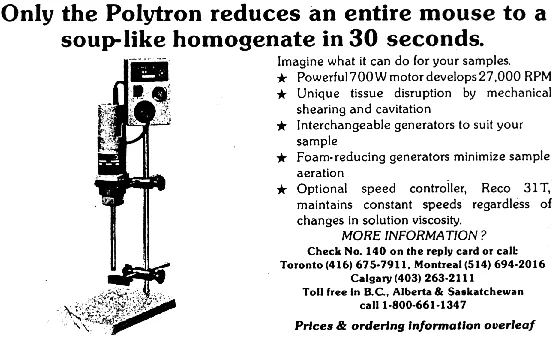
The Polytron ad keeps getting shared. On Reddit, you can spot it on r/vintageads, r/WTF, and elsewhere. It popped up on science Twitter when that was a thing. The Polytron has entered popular (laboratory) culture in a big way. It’s Kevin Simler’s “cultural imprinting” effect in action, within a subculture. And it’s effective. Try finding a lab that processes samples and doesn’t have a Polytron, and look how many scientific papers include Polytron in their materials and methods.
But I have never seen a Polytron used on an entire mouse. Even mouse researchers generally instead [icky mouse processing redacted, you’re welcome]. The ad is terribly non-personalized. The cultural imprinting effect of an long-running campaign, and the attention-getting effect in the reader’s imagination, outweigh the effect that could have been achieved by dropping in an “AI” headline that personalizes a sample type and homogenization time for each reader based on their own research interests.
Cultural imprinting isn’t just a mass media thing, like the often-repeated beer jingles that George Tannenbaum (and many others) remember from baseball games on the radio. Cultural imprinting can work in a subculture or community of practice, if you meet the people where they are. And trying to do that with general-purpose surveillance advertising is less and less effective for more and more communities, where the most engaged people are getting the best privacy protections. Advertising to subcultures and communities of practice is hard, and it gets both harder and more interesting when the people being advertised to are making a point of blocking or even spoofing the conventional measurement tools. Higher-quality ad creative, coupled with high-reputation media buys or sponsorships, are going to be increasingly important for reaching low-surveillablity niche customer communities.
What reminded me of this was The
Paradox Of Personalization: Billions Of AI-Tailored Ads Creates A
Measurement Mess by Erez Levin. We must reject the fantasy of
infinite creative variations – not just because it is technically
impossible but because it fundamentally misunderstands how advertising
works for the vast majority of brands.
(IMHO, brands are a cognitive
hack that uses our existing monkey reputation brain wiring, that we’re
already equipped with at the hardware level, to help us participate in
markets, where are too new on an evolutionary time scale to have
built-in support.)
Brands are built on a collective understanding of what a brand stands for. When you fragment that message into infinite, hyper-personalized silos, you destroy the macro-cultural signal that gives a brand its authority and prestige. It dilutes a shared asset into statistical noise.
Anyway, read the whole thing.
Where cultural imprinting adds risk
In the case of the Polytron, cultural imprinting is a win, because it’s a good idea to have a Polytron in the lab. It works on a large variety of materials, it’s easy to keep clean, it’s surprisingly quiet considering the specs, and if it turns out you don’t need it for now, it only takes a little bit of space and could be useful on a future project.
Cultural imprinting can go both ways, though.
Jessica Orwig, Leon Siciliano, and Lara O’Reilly cover Your
candy ads are about to get a lot more personalized, Mars says.
Rankin Carroll, chief brand officer of Mars Snacking, says the
company behind your favorite candies like M&M’s, Snickers, Skittles,
and Twix is reworking how it advertises to consumers — and the shift
could mean people start seeing very different versions of the same candy
campaign.
Regularly eating high-sugar foods in the middle of the day wasn’t always a thing, and people were probably better off. Cultural changes, driven by advertising, normalized the snacking habit. But now Mars is using “AI” to increase the personalization—which likely means that machine learning systems will “learn” to candymax the people at risk of eating disorders for a quick revenue hit, while pulling back on reinforcing the cultural acceptance. Mars may be opening up an opportunity for cultural imprinting of an alternate habit.icymi: Finally, The True Value Of A Facebook Fan by Bob Hoffman
Bonus links
Trump
admin abandons fight against wind energy as clean energy output
surges by Aman Azhar. This latest victory in a string of legal
setbacks for the administration comes at a time when clean energy
production continues to surge despite a slew of policy, permitting, and
procedural hurdles imposed by the White House.
(fwiw, the attribution cartel
omitted any mention of the environmental impact of its extra data
processing—green stuff is no longer in fashion with the AI-maxing
companies—but they’re increasingly out of touch with regular people
anyway. And maybe even their own
employees?)
Has
AI Already Killed How-To Nonfiction? Sales Trends, My Personal Data, and
What It Might Mean for the Future by Tim Ferriss. ChatGPT,
powered by the updated GPT-3.5 model, launched on November 30, 2022.
There was a gentle -5% slip [in sales of Tim Ferriss books] in 2023,
then -13% in 2024, and then the floor disappears: -46% in 2025, followed
by an even steeper -57% pace this year. If the run-rate holds, my
catalog will sell roughly 80% fewer print copies in 2026 than it did in
2022, with almost all of that happening since LLMs like Claude and
ChatGPT exploded in use.