30 Jul 2025

personalized advertising is an adult custom
New announcement out from YouTube: Extending Protections to More US-Based Teens.
Protections, that sounds good. What are teenage YouTube users getting protected from? The list of protections is:
Showing only non-personalized ads
Enabling digital wellbeing tools by default. This includes
take a break
and bedtime reminders.Showing reminders about privacy when uploading a video or commenting publicly
Minimizing recommendations of videos with content that could be problematic if viewed in repetition
Cool, cool, all makes sense, I can see they’re trying to get teens to
develop healthy online habits, and…hold on a minute, go back to that
first one. Showing only non-personalized ads
is a
protection
now?
Google isn’t going to come out and say that personalized ads are bad
for you, but, using a little logic here, if they say that not showing
you personalized ads is protecting you, it’s the same thing. Yes, this
is similar to the old smoking is an adult custom
messages, back
when the tobacco companies somehow had to come
out in favor of limiting underage sales of cigarettes without admitting
that smoking is harmful in general. If you don’t
smoke, don’t start. And whatever age you’re at now, there are still
health benefits to quitting.
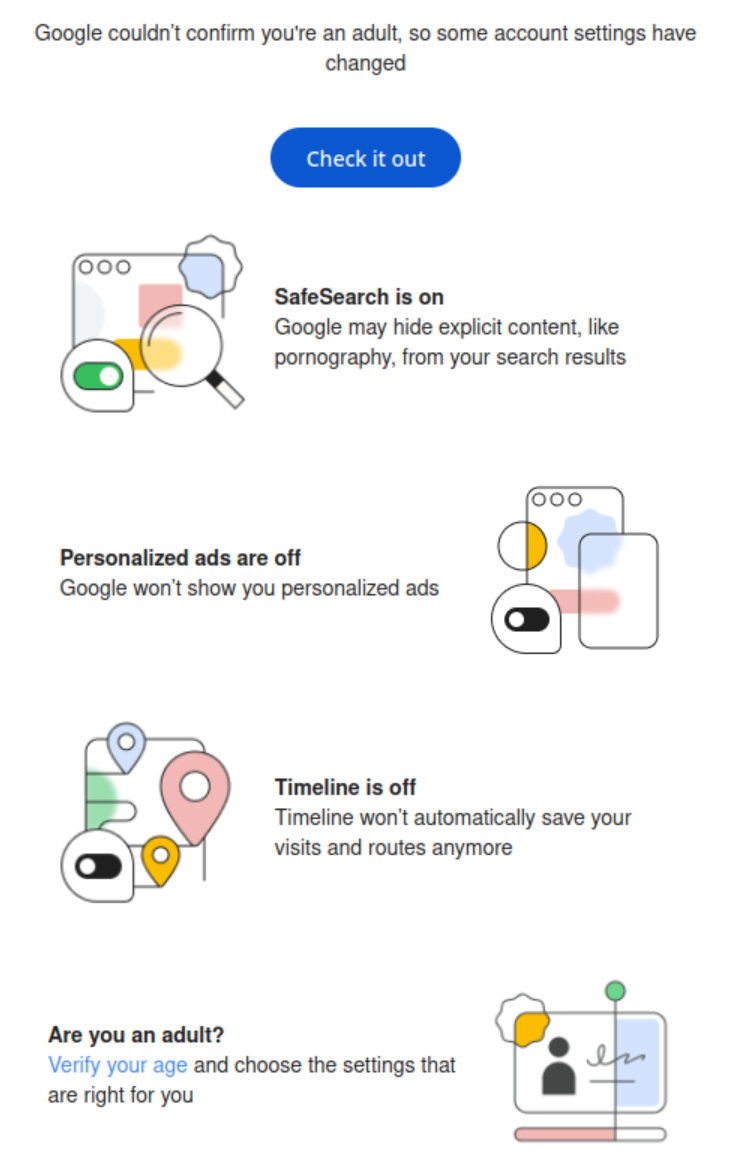
The good news is that you don’t have to be under 18 to be a non-smoker, I mean opted out of risky ad personalization. The Google version of the non-smoking section is a few clicks away—click this to buy better stuff and be happier—and some effective privacy tips will get you some protection on other companies’ sites and apps too. Some of the pro-Google academics are still claiming benefits for personalized ads, but I wonder how long that’s going to be able to hold up. More: advertising personalization: good for you?
Bonus links
‘AI veganism’: Some people’s issues with AI parallel vegans’ concerns about diet by David Joyner (See also Straight edge which, to me, looks more similar so far.)
That Pew
Report Is Sure Looking Like a Foundational Text, Unfortunately by
Nick Heer. The overall trend seems undeniable, however — A.I.
Overviews are generally clobbering search referral traffic. Publishers
are aware of ebbs and flows in search referral traffic. A.I. Overviews
are not having that kind of middling effect.
Meta To Suspend All Political Ads In EU by Colin Kirkland. (Correction: Meta to suspend all political ads from rule-following moderates and liberals. In practice, the extreme right will keep evading the rules, Meta will keep under-staffing the ad review teams so they keep getting away with it, and the left will keep being bad at social media advertising on principle.)
Taylor
Owen: Canadians now see the US as the most serious disinfo threat by
Ethan Zuckerman. Owen warns that Silicon Valley companies have
changed their status. It’s not just performative alignment with Trump:
major platforms are ending the ten year era of
trust and safety
,
turning moderation over to crowdsourcing. These platforms are moving
from minimal transparency to complete opacity. These US government as
well as US platforms are participating in the persecution of
disinformation researchers. And we’re no longer worried about
ideological segregation within platforms so much as we are worried about
platforms becoming tightly aligned with political points of
view.
How
the Kyiv Independent reached 20,000 paying members — with no paywall
by Sarah Scire. The Kyiv Independent connects readers to each other
through monthly events, its Discord, community maps, Ukrainian lessons
with a language tutor, and localized campaigns. More than a third of its
members pinned their location on the outlet’s community map and about
10% of its most-engaged members are active on the Discord…
We
Need To Talk About Sloppers by Rusty Foster. The essential
problem is this: generative language software is very good at producing
long and contextually informed strings of language, and humanity has
never before experienced coherent language without any cognition driving
it.
Money by
Vile Means by Peter Ryan. [T]he speculative frenzy around
cryptocurrencies has only continued to gather steam, to the benefit of
private actors who have reaped massive profits from the industry’s
growth and are exercising a growing influence over the state. In the
process, Bitcoin’s founding goal of fighting unconstrained government
spending has been inverted, as crypto is increasingly serving as a means
of enabling more deficit spending, an agenda the Trump administration
has all but explicitly embraced. Today, crypto is merely the latest ruse
to persuade the public to surrender democratic freedom and financial
sovereignty to oligarchs.