12 Apr 2024

B L O C K in the U S A
(update 22 Apr 2026: update links, copy edit)
(update 16 Mar 2025: add links, add slide from Advertising: Who Cares?)
According to a survey done by Censuswide for Ghostery, a majority of Americans now use ad blockers. Yes, it looks like a well-designed survey of 2,000 people. But it’s hard to go from what people say they’re using to figuring out what kind of ad blocking setup they have in place when they use the web.
Are they answering accurately? People might be under- or over-reporting their use of ad blockers. Under-reporting because they don’t want to admit to free-riding on ad-supported sites, or over-reporting because
install an ad blocker
is now one of the typical Internet tips you’re supposed to do, like not re-using passwords and installing software updates when they come out. People might be trying to look more responsible. When the FBI says you should be running an ad blocker to deal with fake search ads, and the IT department at CERN says, Block ads, stay clean, that puts a certain amount of pressure on people.Are they using an honest blocker with real protection? The ad blocking category has a lot of scams, including adware and paid allow-listing, so most of the people saying yes are not getting the blocking they think they are. (The company that owns the number one ad blocker makes a business out of selling exceptions from blocking. Senator Ron Wyden wrote a letter to the FTC asking them to investigate the ad-blocking industry back in 2020, but no action as far as I know. In the meantime you can check your ad blocker using a tool from the EFF.)
How much of their browsing is on the browser or device that they had in mind when answering the survey? It’s a lot easier to install an ad blocker on desktop than on mobile, and people have different habits.
Is protection being circumvented by server-to-server tracking? Ad blocking has been a thing for a long time, so the surveillance industry has gotten pretty good at working around it. Facebook has responded to Apple ATT and to blockage of their tracking pixels by rolling out server-to-server tracking, which avoids any protection on the client. Google and other companies also have server-to-server tracking. (And they’re trying to get attribution cartel tracking into the browsers.)
Maybe they really just don’t like ads in general. Lin et al. found that running an ad blocker leads to
fewer reported regrets with purchases
andan improvement in subjective well-being.
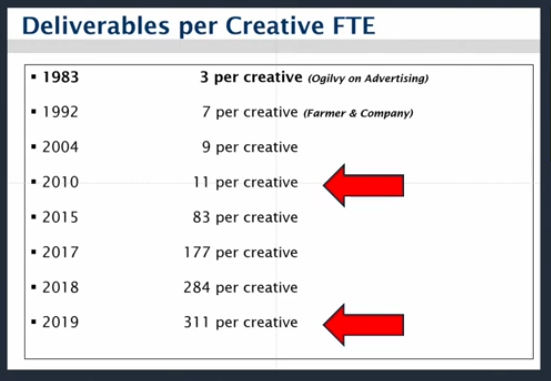
Maybe the simple explanation is just Advertising Makes Us Unhappy. In a study by Miroglio et al., The Effect of Ad Blocking on User Engagement with the Web, users who installed an ad blocker spent significantly more time in the browser (+28% more than control).Maybe ads are just worse now. According to a presentation by Michael Farmer at the Advertising: Who Cares conference, the people who make the ads are having to make more and more. Maybe the ads carry less information for the same amount of interruption and annoyance, and that’s why it make sense to block them. (And it’s not just about the rise of content creation software—most of the increase happened after agency processes had been digital for a while.)
The second most newsworthy part of the new Censuswide survey is
why people say they’re using an ad blocker. Protect online
privacy
is now the number one reason, with block ads
and
speed up page loads
coming in after that. I’ll leave the most newsworthy part to the end. I
know, I know, some people are going to reply with something like, yeah,
right, these ad blocker users are just rationalizing free-riding on
ad-supported sites, like Napster users making bogus fair use arguments
instead of paying for CDs back when that was a thing. But, as Lars
Doucet points out in Ad
Blockers and the Four Currencies, it’s more complicated than
that—many people get a positive integrity dollars
bonus from
punishing or disincentivizing a violation of privacy and honesty norms.
So any guilt over free riding can get balanced out by positive feelings
about denying surveillance data to some kind of bad people on the
Internet. In order to understand the ad blocker survey results, we have
to put the survey in context with other research. Compare to Turow et al. on
attitudes to cross-context tracking, and to an IAB
Europe study that found only 20% of users would be happy for
their data to be shared with third parties for advertising
purposes.
It looks like the privacy concerns are real for a significant subset
of people, and part of the same trend as popular US
State Privacy Legislation. Different people have different
norms around ad personalization, and if people can’t get companies
to comply with those norms they will get the government to do something
about it. For companies, adjusting to privacy norms doesn’t just mean
throwing privacy-enhancing technologies
(PETs) at the problem. Jerath
et al. found similar levels of perceived privacy violations
for on-device ad personalization as for old-fashioned cookie-based
tracking. PETs have different mathematical properties from cookies, but
either don’t address other problems or make them worse.
personalization risks such as discrimination
complexity and information asymmetry
trust
Companies deploying PETs are asking users to switch away from ad blocking and to trust that the companies will do complicated math honestly—but they’re not starting from a position of trust. When users have the opportunity to evaluate the companies’ honesty in a way they do understand, the companies don’t measure up. Most people can look at an online map of their neighborhood and spot places where a locksmith isn’t. And it’s easy to look up a person on a social site and see where there are enough profiles that not all of them can be real.

The biggest problem with PETs will be that the Big Tech companies do
both easy-to-understand activities—like scams, fake profiles, and union
busting—and hard-to-understand activities, like PET math.
I see you served me scam ads and a map with fake
companies in my neighborhood, but I totally trust your math to protect
my privacy
— no one ever If you don’t know if the PET math is
honest, but you can see the same company acting dishonestly in other
ways, then it’s hard to trust the PET math. (Personally I think the PETs
are probably meeting their mathematical goals, but they’re being rolled
out as part of a larger
program to squeeze out legit publishers and other smaller companies,
and to cause
more privacy harms in a harder-to-regulate way.)

(source: How Americans’ confidence in technology firms has dropped: evidence from the second wave of the American Institutional Confidence poll) It would be unrealistic to expect PETs to shift people’s attitudes much on privacy concerns, or to affect ad blocking rates.
The most newsworthy result from the Censuswide study
Maybe another variety of trust issue is behind Censuswide’s most
newsworthy data point: experienced advertisers
(with 5 or
more years of experience in advertising) are more likely to run an ad
blocker than average. (66% > 52%) Reminds me of how
experienced email users were early adopters of spam filters—the more
you know, the more you block. Between sketchy
placements,
bogus
reports
and a
your call is important to us
approach to advertiser support,
the advertisers are having a much worse advertising experience than the
rest of us. The Censuswide survey (full
report PDF) also shows that more experienced advertisers
than
ordinary users believe that the Big Tech companies are likely to
abuse data.
but realistically,
who
knows if they are or not?
The Tragedy of the Commons
is bogus
when it comes to actual traditional practices for managing common
resources, but it is a thing within large companies. Individual
product managers are incentivized to achieve short-term
goals either at the expense of other product managers, by dishonest
practices that spend down the (common across the whole company)
reputation level, or both. For example, within the same large company one business unit can
achieve its goals by selling licensed copies of e-books, while another
business unit can achieve its goals by running ads on infringing copies
of the same titles. Big Tech fans often ask, if these companies are
so distrusted, why do people keep using their products? But another
question is, if these companies are so trusted, why do voters keep
asking the government to take over managing their products? Privacy
settings are hard for users to figure out and easy for companies to
override, but a vote for privacy is easier and sticks better. (and possibly
the one thing that a bitterly divided nation can agree on)
Doc Searls called ad blocking the
biggest boycott in world history
back in 2015. Ad blocking looks
like a response to creepy practices (or perceived privacy
violations
if that works better for you) and those practices are
part of a more general scam culture crisis. Tressie
McMillan Cottom writes,read the whole
thing
Scams weaken our trust in social institutions, but their going mainstream—divorced from empathy for the victims or stigma for the perpetrators—means that we have accepted scams as institutions themselves.
I can’t see any one big policy solution for surveillance advertising, tech oligopolies, or the broader scam culture problem. All of that stuff would have to change in order to move the ad blocking numbers. It’s going to take a variety of approaches, maybe including a surveillance advertising ban, maybe surveillance licensing, maybe a Pigovian tax on databases containing PII, maybe breaking up Big Tech firms. So far the most promising approach seems to be state laws with private right of action, which is one of the reasons I’m so optimistic about Washington State’s My Health My Data Act. My experience on a jury (not an ad-related case) was the most productive meeting I have been in since I came to California. If surveillance advertising issues can grind their way through a few jury trials, where lawyers have an incentive to explain what’s going on in an accurate, comprehensible way, then both surveillance marketers and privacy nerds will be able to reset how we approach this stuff based on more common sense.
More: Sunday Internet optimism
Bonus links
Why Does Ad Tech Still Fail To Spot – And Stop – MFA-Fueled Schemes?
Flying Under The Radar Is Not A Realistic Compliance Strategy
7 Things You Should Know About California’s Privacy Watchdog
Class-Action Lawsuit against Google’s Incognito Mode
CONFIRMED: Elon Musk’s X lost a HUGE brand safety certification after our complaint
Nubai Ventures Sues Outbrain, Claiming Its Traffic Is Riddled With Bots
Critics of the TikTok Bill Are Missing the Point
EU signals doubts over legality of Meta’s privacy fee
They Praised AI at SXSW—and the Audience Started Booing
AI Is Threatening My Tech and Lifestyle Content Mill
There is no EU cookie banner law
A Close Up Look at the Consumer Data Broker Radaris
The FTC’s PrivacyCon Was Chock-Full Of Warning Signs For Online Advertising
How Google Blew Up Its Open Culture and Compromised Its Product
The Tech Industry Doesn’t Understand Consent
Tracking ads industry faces another body blow in the EU
Privacy Sandbox’s Latency Issues Will Cost Publishers
Reminder – Google is enforcing stricter rules for consumer finance ad targeting